
Everyone online is selling you a trading strategy. Almost nobody is teaching you the thing that actually decides whether you keep your money. Here’s what they’re leaving out.
Search for trading content online for more than ten minutes and you’ll be buried in strategies. RSI crossovers. Fibonacci retracement levels. Breakout setups. Candlestick patterns with names that sound like martial arts moves. There’s an entire industry built around selling strategies to retail traders, and it’s extremely good at what it does. What that industry rarely sells you is money management for traders — because it’s harder to make exciting, and it doesn’t lend itself to a highlights reel.
Here’s what nobody in that industry has much incentive to tell you: a strategy is the least important piece of the puzzle. You can have the best entry signal in the world and still blow up your account — wipe out months of careful saving in a handful of bad trades. Plenty of people do it every day, not because their strategy was wrong, but because they had no framework for managing drawdown when things went against them.
The traders who survive long enough to actually get good follow a hierarchy. It looks like this.
The foundation. How you respond to losses, winning streaks, boredom, and the urge to get money back fast. Without the right mindset, every other skill breaks down under pressure. We cover this separately because it deserves its own space.
How much you risk per trade, how you size positions, and how you protect your account from ruin. This is the layer that separates traders who are still around after a year from traders who aren’t. More important than strategy. Rarely discussed.
The actual trade signals — your entry criteria, the patterns you look for, the indicators you use. This is where almost all trading content lives. It matters, but only after the first two are in place.
I want to be specific about why this hierarchy matters for people trading from a desk job at 10pm, using actual savings, with maybe an hour or two to focus on markets before bed.
You are not a hedge fund. You don’t have a risk team, a compliance department, or other people’s capital as a buffer. Your trading capital is the money you saved — it has a real cost in hours worked, and it doesn’t get topped up by an employer if you blow it on a bad streak. Every dollar you lose is a dollar you went to work to earn. And crucially — you can’t watch the market all day. You’ll often be in a trade while you’re in a meeting, or asleep, or on the train. The decisions you make before you enter a trade are the only decisions that count.
That’s what money management is really about: capital preservation first, profit second. It’s the set of rules you commit to before the market opens, so your future self — tired, distracted, or staring at a trade going the wrong way at midnight — doesn’t have to improvise under pressure.
It’s not about picking winners. It’s about making sure that when you’re wrong — and you will be wrong — it doesn’t end you.
10pm Trader — Money & Risk Management
The First Question: How Much Are You Willing to Lose on This Trade?
Most people approach this backwards. They decide how much they want to make, then figure out how big a position they need to achieve that target. This is the wrong order of operations entirely.
The right question is: if this trade goes against me, how much of my account am I prepared to lose? That number — defined precisely, in dollars, before you hit the buy button — is your risk per trade. Everything else is built around it.
The standard professional rule is to risk no more than 1% to 2% of your total account on any single trade. For most retail traders, 1% is the right starting point. It sounds conservative. It is conservative. That’s the point.
Ten losses in a row sounds extreme. It isn’t, if your win rate is around 50% — which is realistic for most retail traders. Most account blowups don’t happen from one catastrophic trade. They happen from a string of ordinary losing trades where the position sizes were too large to absorb. With 1% risk, that losing streak hurts but it doesn’t end you. You can recover. You learn from it and come back. That’s the whole point of keeping losses small: it buys you time, and time is how you get better.
An important distinction: risking 1% doesn’t mean you only put 1% of your account into a trade. It means you only stand to lose 1% if the trade goes the maximum distance against you. Your actual position size might be larger — but it’s paired with a stop-loss that limits your downside to that 1% figure. More on stop-losses in a moment.
The Stop-Loss: The Most Important Order You’ll Ever Place
A stop-loss is a price level you define before entering a trade. If the market reaches that level, the trade closes automatically. Your loss is locked in at the amount you decided to risk upfront — and not a cent more.
This sounds simple. In practice, most people don’t do it. Or they set one, watch the trade move toward it, and manually cancel it because they’re convinced it’ll turn around. I’ve done this. It rarely turns around.
The stop-loss is not a prediction that the price will fall. It’s an acknowledgement that you might be wrong, and a commitment to how much being wrong is allowed to cost you. It takes the decision out of your hands in the moment when you’re least equipped to make it clearly.
For a 10pm Trader in particular, the stop-loss is non-negotiable. You will be away from your screen. Gaps happen. News drops at 2am. Without a stop-loss, a trade you entered with $100 of intended risk can turn into a $1,000 loss while you’re sleeping. With one set as an actual order in the platform before you close your laptop, you wake up knowing the worst-case outcome you’ve already agreed to.
Set the stop-loss as a real platform order before you enter the trade. Not a mental note. An actual order.
Position Sizing: The Maths Behind Risk Management in Trading
Once you know your maximum risk in dollars and where your stop-loss sits, your position size — sometimes called your lot size — is simple arithmetic. You’re not guessing based on conviction. You’re calculating.
Position Size Formula
Position Size = Account Risk ($) ÷ Trade Risk ($ per unit)
Account Risk = Total Balance × Risk %
Trade Risk = Entry Price − Stop-Loss Price
Notice what happened there. The total position value is $3,000, but because the stop-loss caps the maximum loss at $100, the actual risk is 1% of the account regardless. This is the distinction most beginners miss — it’s not about how much money is in the trade, it’s about how much you can lose if the trade fails.
Risk-to-Reward: Making Sure the Numbers Work in Your Favour
Position sizing controls what happens when you lose. The risk-to-reward ratio (RRR) controls whether you’re profitable over time even if you lose more often than you win.
The RRR compares what you stand to gain versus what you stand to lose on a trade. A ratio of 1:2 means you’re targeting twice the gain as your maximum loss. A ratio of 1:3 means three times.
Or in price terms:
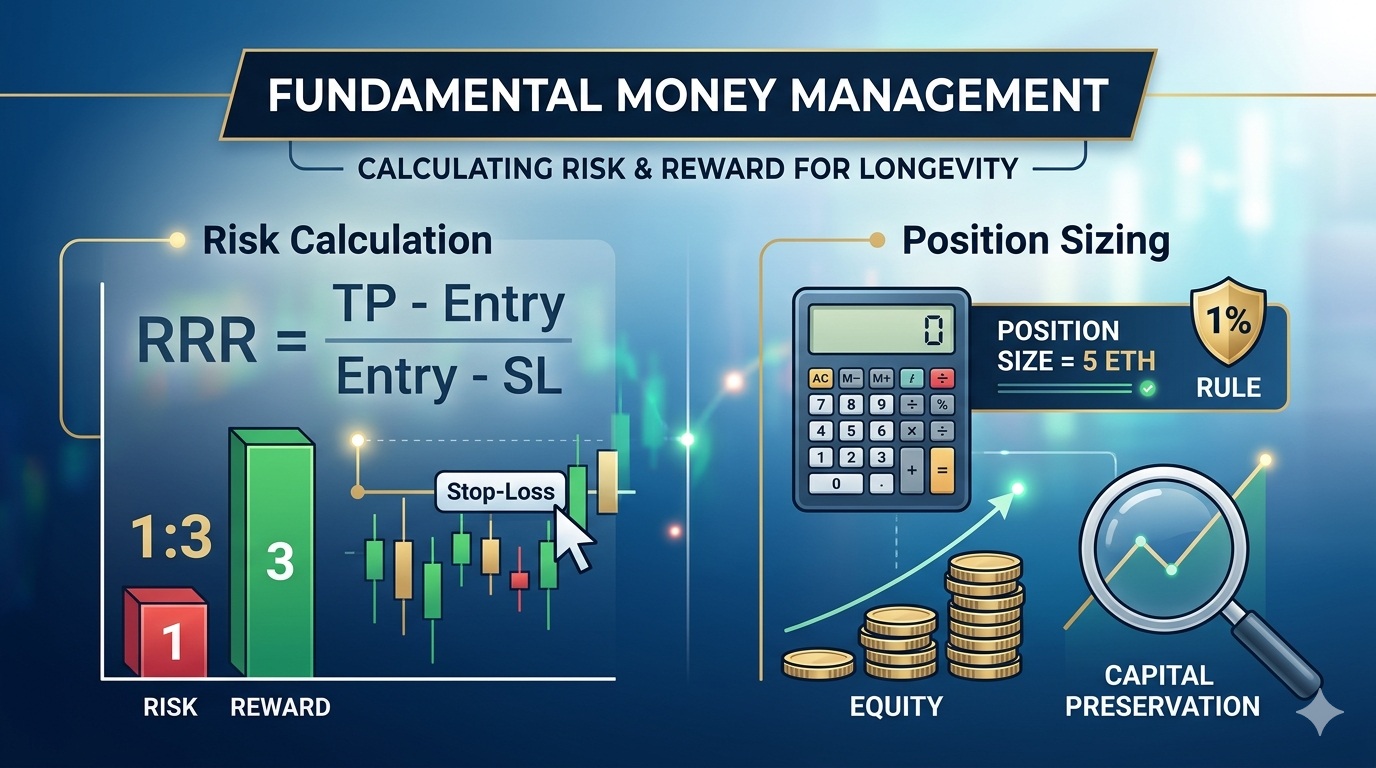
RRR = (Take-Profit Price − Entry) ÷ (Entry − Stop-Loss Price)
Why does this matter so much? Because it changes what win rate you need to be profitable. With a 1:2 RRR, you only need to win 34% of your trades to break even — and anything above that is profit. With a 1:3 RRR, that number drops to 25%. This is the mathematical case for why strategy is secondary to money management: a mediocre strategy with disciplined risk-reward will outperform a brilliant strategy where you’re taking 1:0.5 trades.
Traders use the term positive expectancy to describe this property. Expectancy is simply the average amount you expect to make per trade, accounting for both your win rate and your risk-reward ratio. A system with a 40% win rate and a 1:2 RRR has positive expectancy — it makes money over time even though it loses more often than it wins. A system with a 60% win rate but a 1:0.5 RRR has negative expectancy — it loses money over time despite winning most trades. Win rate alone tells you almost nothing useful. Win rate combined with risk-reward tells you everything.
As a starting rule: don’t take a trade where your risk-to-reward is less than 1:2. If the setup doesn’t offer at least twice the potential gain versus your defined risk, skip it. The market will give you another opportunity.
This connects to something that doesn’t get discussed enough for people like us — the fact that not trading is a valid choice. If there’s no trade worth taking tonight, the right move is to close the laptop and go to sleep. The account is the same size tomorrow. Forcing a trade to feel productive is how 1% risk per trade becomes a habit of 4% losses on bad setups.
A Quick Note on More Advanced Techniques
The three concepts above — position sizing, stop-losses, and risk-to-reward — are the foundation. Get those right and you’re already ahead of most retail traders. But there are several more advanced money management tools worth knowing exist, even if we’re not going deep on them here. I’ll cover each in a dedicated article.
Closing part of your position — say 50% — when the trade is up significantly, while letting the rest run. You lock in guaranteed profit while staying exposed to further upside. For a 10pm Trader, this is particularly valuable: you bank real money before you go to sleep, and the remaining position can run overnight with a breakeven stop protecting it. It also removes the emotional pressure of watching an open profit evaporate, which is one of the most common reasons traders exit winning trades too early.
Once a trade moves meaningfully in your favour — typically when it’s halfway to your take-profit — you move the stop-loss up to your entry price. You can no longer lose money on the trade. The worst case becomes a scratch rather than a loss, which changes the psychological experience of holding a position overnight entirely. It’s one of the most practical tools in part-time trading because it means you can walk away from the screen without worrying about a winning trade turning into a loss while you’re not watching.
The opposite of doubling down after losses. Instead, you only increase position sizes when your account is growing — and you scale them back when you’re in a drawdown. This protects your original trading capital during losing streaks (when you’re most likely to be emotionally compromised and making poor decisions) and compounds gains naturally during winning periods. The Martingale approach — doubling up after losses to recover faster — is how retail traders turn manageable drawdowns into account-ending events.
If you’re long on five different crypto altcoins that all move with Bitcoin, you’re not diversified — you effectively have one giant trade with five times the intended risk. When Bitcoin drops 8%, all five positions move against you simultaneously. Understanding how your open positions relate to each other is a key part of managing total portfolio risk rather than just per-trade risk. Before opening a new position, check whether it’s likely to move in the same direction as something you’re already holding.
A stop-loss that moves automatically as the price moves in your favour — locking in progressively more profit as the trade develops, while still giving it room to run. If a trade moves up 10%, the trailing stop moves up 10% too, preserving most of the gain if the price reverses. Most trading platforms support trailing stops as a native order type. Particularly useful for swing trades held over several days, where manually adjusting a stop-loss every session becomes impractical.
Setting a hard cap — say 3% of account — on how much you’ll lose in a single session before you stop trading entirely for the day. Prevents the revenge-trading spiral where one bad loss triggers increasingly reckless trades in an attempt to get the money back fast. Prop firms enforce daily loss limits as a contractual condition. For retail traders, self-enforcement requires real commitment — but it’s one of the most effective safeguards against the kind of single-session account blowup that takes months to recover from.
Putting It Together: Your Pre-Trade Checklist
Before you enter any trade — crypto, stocks, whatever the instrument — these are the four questions you answer first. If you can’t answer all four clearly, you don’t enter.
And once the trade is closed, those same four answers belong in your trading journal alongside the outcome. Pattern recognition across your own trades — which setups hit your take-profit, which regularly stopped out, what your actual risk-to-reward is in practice versus what you planned — is how money management improves over time. The checklist below is the entry. The journal is the feedback loop.
| Question | What It Means in Practice |
|---|---|
| Where is my stop-loss? | A specific price level, defined in advance, set as a real platform order before you enter the trade. |
| How much will I lose if it hits? | This should be 1–2% of your total account balance. Calculate it from position size and stop distance — not intuition. |
| Where is my take-profit? | A specific price level that gives you at least a 1:2 risk-to-reward ratio relative to your stop-loss. If that level doesn’t exist in a realistic part of the chart, the trade isn’t worth taking. |
| What is my position size? | Calculated from your account risk (Step 2) and trade risk (stop distance). Not based on how confident you feel. |
The hard truth about longevity: The traders who are still around after three, five, ten years are almost never the ones who had the best strategy. They’re the ones who lost slowly enough, and learned fast enough, to still have an account when their edge finally developed. Money management is what buys you that time.
We are trading our own savings. We are not doing this for a living. Every dollar lost is a dollar that went somewhere we could have used it. There’s no capital cushion, no salary to absorb drawdowns, no risk manager to pull us out of a bad trade. The discipline has to come from us — and it has to come in advance, before emotions are running.
Frequently Asked Questions
What is the 1% rule in trading?
The 1% rule means you never risk more than 1% of your total account balance on a single trade. On a $10,000 account, that’s $100 maximum per trade. The rule isn’t about how much you put into a position — it’s about how much you stand to lose if your stop-loss is hit. It’s the most widely cited money management guideline in retail trading because it limits drawdown to survivable levels even during a prolonged losing streak.
What is a good risk-to-reward ratio for retail traders?
A minimum of 1:2 is the standard starting point — meaning you’re targeting at least twice as much profit as your maximum defined loss. A 1:3 ratio is better still. Both ratios mean you can lose the majority of your trades and still be profitable over time, which is a realistic expectation for most retail traders. Avoid taking trades with a risk-to-reward below 1:1.5, as the maths work against you unless your win rate is exceptionally high.
How do I calculate position size for a trade?
Divide your account risk (your account balance multiplied by your risk percentage) by your trade risk (the difference in price between your entry and your stop-loss). For example: $100 account risk ÷ $2,000 price difference = 0.05 BTC position size. The result tells you exactly how many units to buy so that if the stop-loss is triggered, you lose only the amount you agreed to risk upfront.
Is money management more important than having a good strategy?
Yes — and the data backs this up. A study of over 25,000 individual traders covering more than 4 million trades found that around 65% of them won more trades than they lost — a win rate above 50%. And yet 82% of those same traders lost money overall. The reason: their average winning trade gained about 1.2%, while their average losing trade cost them 2.8%. Being right more often than not wasn’t enough to overcome the math. Strategy got them into winning trades. The absence of risk discipline is what took the money back. Read the full breakdown of retail trader loss statistics →
What is drawdown in trading?
Drawdown is the peak-to-trough decline in your account balance during a losing period. If your account goes from $10,000 to $7,500 before recovering, that’s a 25% drawdown. Keeping individual trade risk at 1–2% limits how deep a drawdown can get before your system recovers, which is especially important when you’re trading part-time and can’t actively manage positions throughout the day.
The goal of money management isn’t to avoid losing. Losses are part of trading — anyone who tells you otherwise is selling something. The goal is to make your losses survivable, so you’re still in the game when your edge works. Survive long enough, and you give yourself a chance. That’s the whole job.