
And what government regulators, peer-reviewed academics, and broker disclosures actually say about it.
Understanding why retail traders lose money is one of the most important and most ignored questions anyone can ask before they open a trading account.
Key Takeaways
- Between 70% and 97% of retail traders lose money, depending on the instrument — every major study arrives at this range.
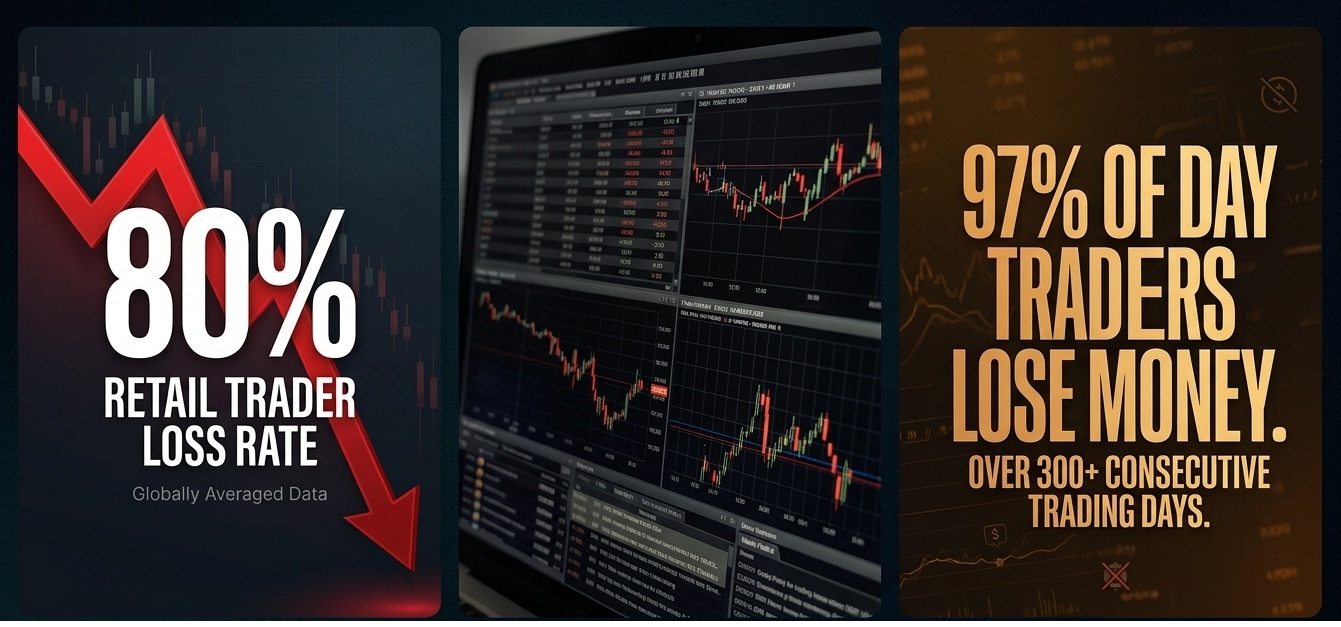
- A peer-reviewed study of committed futures day traders found 97% lost money, even after 300+ days of persistence.
- India’s market regulator SEBI officially documented that 93% of retail F&O traders lost money across three years of data (FY2022–FY2024).
- The retail trader failure rate has not improved in 27 years of data, despite better platforms, tools, and educational content.
- 82% of traders lose money overall — even those with win rates above 50% — due to taking profits too early and holding losses too long.
- The traders who do succeed consistently treat it as a multi-year craft, not a shortcut. They make up roughly 1–3% of active traders.
Someone in your circle is making money trading. Or at least that’s what it looks like. Maybe it’s a friend who won’t stop talking about his crypto gains. Maybe it’s an influencer on your feed, laptop open on a beach, two phones, a Rolex, offering to teach you his “proven system” for a few hundred bucks. Or maybe it’s just the group chat, everyone talking about options, and you’re sitting there feeling like you’re missing the boat.
I get it. That feeling is real, and it’s powerful. I’ve felt it too.
But here’s what I want to share with you, not because I’m trying to talk you out of trading, because I’m not, but because nobody told me this clearly when I was starting out, and I wish they had.
The vast majority of people who actively trade lose money. Not a slim majority. Not just the careless ones. The majority. Consistently. Across every instrument studied. And the research proving this doesn’t come from anonymous bloggers — it comes from government regulators, peer-reviewed academic studies, and legally mandated broker disclosures. The kind of sources that don’t have a reason to exaggerate. This is the core of why retail traders lose money, and it has nothing to do with bad luck.
So before you fund that account tonight, let’s talk about what the data actually says.
The most reliable way to beat 80% of retail traders is devastatingly simple: don’t trade until you’re actually ready.
10pm Trader — the uncomfortable truth
What Percentage of Retail Traders Lose Money?
In 2020, three economists published what is probably the most rigorous study ever done on day trading. They looked at everyone who started day trading Brazil’s equity futures market, the third largest futures market in the world by volume, between 2013 and 2015. Crucially, they only studied people who committed to it for at least 300 trading days. Not people who dabbled and quit. People who showed up day after day and kept at it.
Their finding: 97% of them lost money. Just 0.4% , less than half a percent, made more than a bank teller’s wage. The very best performer in the dataset made around $310 a day on average, with a standard deviation of $2,560, meaning his results swung wildly enough on any given day to wipe out a full week of gains.
According to a peer-reviewed study by Chague, De-Losso and Giovannetti (2020), 97% of committed futures day traders who persisted for at least 300 trading days still lost money. That’s not a beginner problem. That’s a structural problem, and it shows up everywhere you look.
97%
of committed futures day traders lost money — even after 300+ days of persistence
Chague, De-Losso & Giovannetti (2020) — peer-reviewed
93%
of Indian retail futures & options traders lost money across a three-year study period
SEBI official report, September 2024
84%
of new crypto traders lose money within their very first year of trading
NFTEvening survey, August 2025 (n=1,005)
~80%
of retail traders lose across forex, CFDs, and stock day trading globally
ESMA + CFTC mandatory regulatory disclosures
Retail Trader Loss Rates by Instrument: Forex, Options, Crypto and More
India’s market regulator, SEBI (their equivalent of the SEC) released an extraordinary report in September 2024. They took three full years of actual trading data (FY2022 to FY2024) and published the results publicly. What they found: 93% of retail investors trading futures and options lost money. On average, each trader was down about Rs 2 lakh (roughly $2,400 USD) over those three years.
Now here’s the part that should make your stomach drop. On the other side of those trades? Proprietary trading firms made Rs 33,000 crore in FY24 alone. Foreign portfolio investors made Rs 28,000 crore. And 97% of those institutional profits came from algorithmic trading — automated systems running on servers that execute orders in microseconds, informed by more data than any individual retail trader could ever process.
When you make a trade, there’s someone on the other side of it. And increasingly, that someone is a machine built by a team of PhDs with access to infrastructure you don’t have. That’s not a conspiracy, it’s just the market.
In Europe, regulators made things more transparent by requiring it. Under rules from the European Securities and Markets Authority (ESMA), any broker offering CFDs or forex products is legally required to disclose — right on their website, in plain sight — the percentage of their clients who lose money. ESMA’s own analysis of those disclosures showed that between 74% and 89% of retail traders lose money on CFDs and forex. The US CFTC reports numbers in the same range: 70% to 80% of retail forex traders are unprofitable. When someone averaged the disclosures across 35 major brokers, the 2024 figure came out to 86% of all retail forex traders in the red.
Options? A 2025 study from the University of Florida’s Warrington College of Business found that retail traders lost money across every measured time period when trading complex multi-leg options, averaging a 16.4% loss over just three days. Losses were three times larger on earnings announcement dates, exactly when retail traders think they have an edge. A separate London Business School study calculated that retail options traders collectively lost over $2 billion in options premium between 2019 and 2021 alone.
And crypto? A survey of 1,005 retail crypto traders conducted in August 2025 found that 84% lost money in their first year, with 58% losing nearly all of their starting capital. The two most common causes were poor research (55%) and FOMO, fear of missing out (44%). Which, if you’ve spent five minutes on crypto Twitter, won’t surprise you at all.
The 27-Year View
A longitudinal study drawing on 28 years of trading data, 8 million trader profiles and 295 million trades from 1998 to 2025, arrived at a conclusion that’s almost eerie in its consistency.
The retail trader failure rate has not moved. Not during the dot-com boom. Not during the 2008 crash. Not during COVID. Not during the crypto bull runs. In every single period measured, 74% to 89% of retail traders lost money.
Better platforms. More educational content. More accessible tools. None of it changed anything. Because the problem was never information. It was behaviour.
After nearly three decades of evidence, why retail traders lose money is no longer a mystery. It’s behaviour, not information.
Why Traders Lose Even When They Win More Trades Than They Lose
A 2023 study looked at over 25,000 retail traders across more than 4 million trades. It found something that sounds almost impossible at first: about 65% of the traders actually won more trades than they lost. A win rate above 50%. By any normal standard, they were picking right more often than wrong.
And yet, 82% of those same traders lost money overall.
How? Because their average winning trade gained about 1.2%. Their average losing trade cost them 2.8%. They were right more than half the time, but every time they were wrong it hurt twice as much as every time they were right helped. Over enough trades, the math grinds them down to a loss.
Why does this happen? Because we’re human. Seeing a profit makes us nervous — what if it disappears? So we close the trade early and lock in the gain. Sitting on a loss feels awful — surely it’ll recover? So we hold. And hold. And hold. We take profits too early and let losses run too long. Across millions of trades and thousands of traders, this pattern repeats with almost mechanical reliability. MIT Sloan professor Eric So, whose research covered 32,791 earnings announcements over more than a decade, described retail investors making a “trio of wealth-depleting mistakes”, and none of them have anything to do with not knowing enough chart patterns. It’s not a knowledge problem. It’s a behaviour problem. And it’s the hardest kind to fix.
A note on survivorship bias. The influencer posting his gains isn’t necessarily lying. He may have genuinely had a great run. What he isn’t showing you is the dozen people who ran the exact same strategy and blew up their accounts. They stopped posting. You don’t follow them. So your feed becomes a highlight reel that looks like evidence, but is actually just selection.
The Full Loss Rate Data: Every Instrument, Every Source
| Instrument | % Who Lose | Source |
|---|---|---|
| Futures — Day Trading | ~97% | Chague, De-Losso & Giovannetti (2020), Brazilian equity futures market Peer-reviewed academic study Read the paper → |
| F&O — India (Options & Futures) | 93% | SEBI official study, Sept. 2024, covering FY22–FY24 Government regulator report Read the report → |
| Crypto — First Year | 84% | NFTEvening survey of 1,005 retail crypto traders, August 2025 Primary survey research Read the report → |
| Options (Complex / Multi-leg) | ~82% | University of Florida, Warrington College (2025); London Business School (2019–2021) Academic research Read the UF report → |
| Forex | 70–89% | ESMA mandatory CFD/forex broker disclosures; CFTC regulatory data Regulatory — legally mandated disclosure ESMA report → |
| CFDs (Contracts for Difference) | 67–80% | Mandatory EU/UK broker disclosures averaged across 35+ brokers Regulatory — legally mandated disclosure Analysis → |
| Stocks — Day Trading | ~80% | Barber, Lee, Liu & Odean — Taiwan Stock Exchange, 1992–2006; Korean futures studies Peer-reviewed academic study Read the paper → |
| DIY Buy-and-Hold Investors | ~70% | Financial Times data; Barber & Odean — individual investors underperform index by ~1.5%/yr Academic research + industry data |
Who Actually Profits from Trading — And What Sets Them Apart
Look, I’m not here to tell you that trading is impossible or that nobody succeeds. People do. Research consistently finds that somewhere between 1% and 3% of active retail traders are durably profitable. They exist. They’re real.
But here’s what that small group has in common, and it’s not a hot tip or a secret indicator. It’s that they treated trading like a craft. They spent years, not weekends, not a month on a demo account, developing actual skill. They kept journals. They tracked every trade, every mistake, every emotional decision they made and why. They started with position sizes so small that a loss genuinely didn’t hurt, because early losses are tuition and you want to keep tuition affordable. They failed, adjusted, and came back with more knowledge and more discipline than they had before.
That’s a very different story from the one being sold on social media. And it’s worth sitting with that gap for a moment.
If you’re trading in the evening hours like I do, working a full-time job, looking after a family, squeezing in a couple of hours when everyone’s asleep, then your time is genuinely precious. The question isn’t just “can I make money trading?” It’s “am I spending this limited time building real skill, or am I gambling on the feeling that I know something the market doesn’t?”
The majority of people who open an account tonight will be in the 80%. Not because they’re not smart. Because they haven’t put in the preparation that this kind of competition demands. The market doesn’t care that you had a rough day at work, that you need to make rent, or that a KOL made it look easy. It’s indifferent in a way that very few things in life actually are.
How to Avoid Becoming Another Losing Retail Trader
None of this is an argument for financial paralysis. It’s an argument for honesty about what you’re actually doing when you open a trading app on your phone because you saw a TikTok.
Before you risk a single cent, spend serious time on education. Paper trade for months, not days. Learn how to read a chart properly. Understand position sizing and what it means to risk 1% per trade. Read about trading psychology, because the data is unambiguous that your biggest enemy in the market is yourself. Figure out what kind of trader you want to be and then stick to that approach for at least 30 to 50 real trades before you decide whether it’s working. Don’t strategy-hop the moment something doesn’t go your way. That’s one of the fastest routes to blowing an account.
If after all of that you’re still consistently losing, the honest answer is: don’t trade. Sitting in cash is a completely legitimate strategy. Walking away from a competition you’re not yet equipped to win isn’t weakness, it’s the first intelligent decision a trader ever makes.
The goal isn’t to trade. The goal is to make money. That gap between the goal and the method is exactly why retail traders lose money at such consistent rates.
Sometimes those are the same thing. Often, especially at the start, they’re not.
This is the kind of article I wish I’d read when I first started. File it under things that are obvious in hindsight and completely invisible in the moment when the group chat is going off and everyone seems to be winning.
Frequently Asked Questions
What percentage of retail traders lose money?
Between 70% and 97% of retail traders lose money, depending on the instrument. A 2020 peer-reviewed study found 97% of committed futures day traders lost money after 300+ days. SEBI’s 2024 official report documented 93% of Indian retail F&O traders losing money over three years. ESMA and CFTC regulatory data consistently places forex and CFD retail trader losses at 70–89%. The figure is above 70% regardless of the market studied.
What percentage of day traders lose money?
Approximately 80% of stock day traders lose money net of transaction costs, based on Barber, Lee, Liu and Odean’s landmark study of Taiwan’s stock market covering 14 years of data. For futures day traders specifically, the figure rises to approximately 97% among those who persisted for at least 300 trading days. Only around 1.6% of all day traders are consistently profitable in any given year.
Do most retail forex traders lose money?
Yes. Between 70% and 89% of retail forex traders lose money, according to two separate financial regulators. ESMA found 74–89% of retail traders lose on forex and CFDs based on legally mandated broker disclosures. The US CFTC consistently reports 70–80% of retail forex traders are unprofitable. An analysis averaging disclosures across 35 major brokers put the 2024 figure at 86%.
Why do traders lose money even with a win rate above 50%?
A 2023 study of 25,000 retail traders found that 65% had win rates above 50% — yet 82% of those traders still lost money overall. The reason is asymmetric trade sizing: their average winning trade gained around 1.2%, while their average losing trade cost 2.8%. Traders instinctively close winning trades early (fear of losing the gain) and hold losing trades too long (hope of recovery). Over enough trades, this destroys returns regardless of win rate.
Is crypto trading profitable for beginners?
No, not typically. A survey of 1,005 retail crypto traders conducted in August 2025 found that 84% lost money in their first year, with 58% losing nearly all of their starting capital. Day trading was the primary cause, chosen by 54% of first-year traders. The two most common mistakes were poor research (55%) and FOMO — fear of missing out (44%).
How long does it take to become a consistently profitable trader?
Research by Barber, Lee, Liu and Odean suggests that consistently profitable day traders typically have multiple years of real market experience. The small subset of retail traders who are durably profitable — estimated at 1–3% of all active traders — share a common path: years of deliberate practice, meticulous trade journaling, disciplined risk management, and starting with very small position sizes. There is no evidence that short courses or demo trading alone produces consistent profitability.
Has the retail trader failure rate improved over time?
No. A longitudinal study covering 28 years of trading data (1998–2025), 8 million trader profiles, and 295 million trades found that the retail trader failure rate of 74–89% has not changed over nearly three decades. This held across the dot-com crash, the 2008 financial crisis, the COVID boom, and multiple crypto cycles. Researchers concluded that losses are primarily behavioural — better tools and education have not moved the needle.
Sources & Further Reading
- Chague, F., De-Losso, R., & Giovannetti, B. (2020). Day Trading for a Living? SSRN Working Paper. ssrn.com
- SEBI. (September 2024). Study on Profit and Loss of Individual Traders Dealing in Equity F&O Segment. sebi.gov.in
- ESMA. Final Report on CFDs. European Securities and Markets Authority. esma.europa.eu
- Barber, B., Lee, Y., Liu, Y., & Odean, T. (2014). Do Day Traders Rationally Learn About Their Ability? UC Berkeley Haas. faculty.haas.berkeley.edu
- MIT Sloan School of Management. (2022). Retail Investors Lose Big in Options Markets, Research Shows. mitsloan.mit.edu
- University of Florida, Warrington College of Business. (2025). Retail Investors Play a Losing Game with Complex Options. warrington.ufl.edu
- NFTEvening. (August 2025). 84% of Retail Crypto Traders Lose Money in Their First Year. nftevening.com
- PiP World / Hedge Fund Alpha. (2025). Retail Traders Lost 74–89% During Every Major Volatility Event: Study. hedgefundalpha.com
- Investing.com. (2025). How the Top 1% of Traders Think: Data-Backed Lessons from 25K Accounts. uk.investing.com
- CFTC. (2024). Retail Traders in Futures Markets. US Commodity Futures Trading Commission. cftc.gov