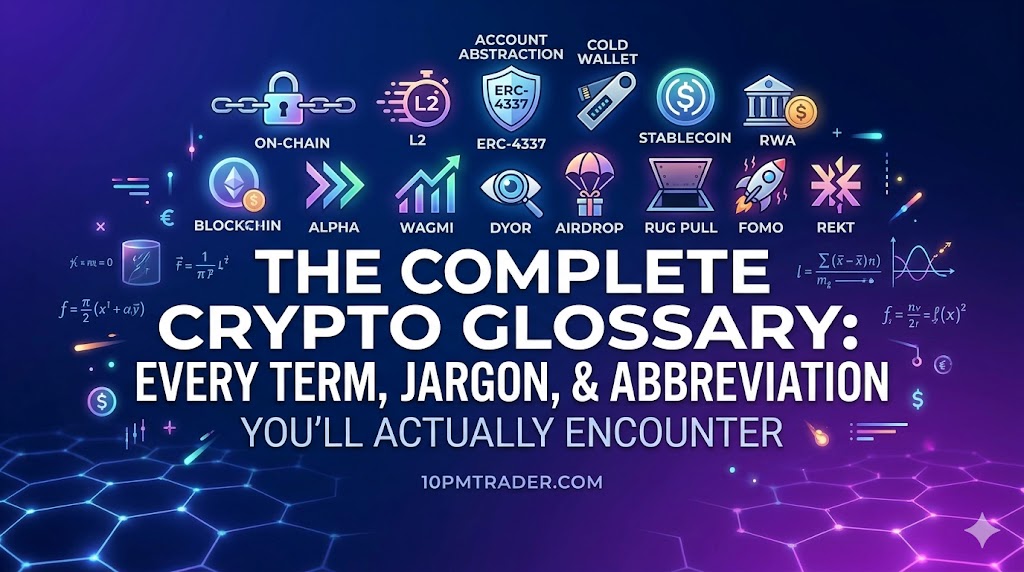
If you’re looking for crypto terms for beginners explained in plain English, you’re in the right place. New to crypto and feeling lost every time you open a Discord, watch a YouTube video, or scan a trading forum? This plain-English crypto glossary is the reference I wish I’d had when I started. Every term, abbreviation, and piece of slang — explained simply, with no jargon to explain the jargon.
I’ve broken it into three sections: the technical foundations, the trading lingo, and the culture and safety terms you need to navigate the community without getting burned. It’s a long read — bookmark it, come back to it, use it as a reference. Don’t let the slang intimidate you. Use this guide to filter out the noise so you can focus on what actually matters: protecting your capital and finding real opportunities.
Section 1: Blockchain and Crypto Basics
If you don’t understand the infrastructure, you can’t fully trust the asset.
You don’t need to be a developer to trade crypto. But you do need to understand enough of the plumbing to know where the risks are. Most people skip this section and go straight to charts. That’s usually where the expensive lessons come from.
On-chain
Meaning: Data recorded directly and permanently on the blockchain.
In plain English: Like a transaction appearing on a public bank statement that the whole world can see. Permanent, transparent, and tamper-proof.
Off-chain
Meaning: Data handled outside the main blockchain to save on speed or cost.
In plain English: Like a tab at a bar. You buy all your drinks “off-chain,” and only the final total hits your card “on-chain” at the end of the night.
Gas / Gas Fees
Meaning: The fee paid to process and validate a transaction on a blockchain network.
In plain English: A toll booth on the highway. You pay it every time you move funds or execute a smart contract. The more congested the network, the higher the toll — and on Ethereum at peak times, it can be eye-watering. I’ve paid more in gas than the transaction was worth more than once. It happens.
Smart Contract
Meaning: Self-executing code stored on the blockchain that automatically enforces the terms of an agreement when predefined conditions are met.
In plain English: A vending machine. You put in the right input, it automatically gives you the right output — no middleman, no paperwork, no one who can change their mind at the last second.
L2 (Layer 2)
Meaning: A secondary framework built on top of a main blockchain (like Ethereum) to make it faster and cheaper.
In plain English: An express lane on a highway. It handles the bulk of the traffic so the main road doesn’t get jammed — and your gas fees drop significantly as a result.
CEX vs DEX (Centralised Exchange vs Decentralised Exchange)
Meaning: A CEX is a company-run platform that holds your funds and matches buyers with sellers (think Binance or Coinbase). A DEX is a blockchain-based protocol where you trade directly from your own wallet with no company in the middle.
In plain English: CEX is a traditional brokerage — convenient, regulated, but they hold your funds. DEX is a vending machine with no staff: it runs on code, you stay in control of your money, but you’re also responsible if something goes wrong. The old crypto saying applies: “Not your keys, not your coins.”
On-ramp
Meaning: Any service or platform that allows you to convert traditional fiat currency (like USD, SGD, or EUR) into cryptocurrency.
In plain English: The entrance gate. An on-ramp is how your regular money becomes crypto — whether that’s buying Bitcoin with your credit card on Coinbase, using a bank transfer on an exchange, or tapping a crypto ATM. The term comes from highway on-ramps: you’re accelerating from the regular road (fiat) onto the crypto highway. On-ramps vary widely in fees, speed, and which payment methods they accept, so it’s worth comparing before you commit.
Off-ramp
Meaning: Any service or platform that allows you to convert cryptocurrency back into fiat currency and withdraw it to a bank account or other traditional payment method.
In plain English: The exit gate. After you’ve traded or earned crypto, an off-ramp is how you turn it back into spendable money in your bank account. This sounds straightforward but it’s one of the more friction-heavy parts of crypto — exchanges may require full KYC verification before they let you withdraw fiat, transfers can take days, and depending on your country, you may trigger tax reporting obligations the moment you off-ramp. Always know your off-ramp before you put significant money in.
Cold Wallet
Meaning: An offline hardware device (like a Ledger or Trezor) used to store your crypto private keys.
In plain English: A high-security floor safe. Since it’s completely disconnected from the internet, it’s nearly impossible to hack remotely. If you’re holding anything significant long-term, this is not optional.
Private Key
Meaning: A unique cryptographic string of characters that proves ownership of a wallet and authorises every transaction you make.
In plain English: The actual key to your safe. Your seed phrase is how you make a copy of that key if you ever lose it. Guard both with equal paranoia.
Seed Phrase
Meaning: A 12–24 word master key that grants total access to your wallet and all assets inside it.
In plain English: The master key to your vault. Lose this, you lose your money — permanently, with no recovery. In 25 years of IT, I’ve seen many “unhackable” things get hacked. But losing your seed phrase isn’t a hack. It’s just gone. Write it down. Store it offline. Never share it with anyone, ever. This one I don’t say lightly.
Account Abstraction (ERC-4337)
Meaning: Technology that transforms a standard crypto wallet into a programmable “smart account” governed by code rather than a single private key.
In plain English: Upgrading a dumb prepaid card to a full banking app. It allows for “social recovery” (so you can regain access without a seed phrase), sets spending limits, and lets you pay transaction fees in stablecoins instead of ETH. Still early, but this is likely where wallets are heading.
Section 2: Crypto Trading Terms and Abbreviations
This is the language of the market in 2026. If you want an edge, start here.
This section is the one I’d go back and give myself on day one. Not the chart patterns, not the indicators — this. Understanding how assets are valued, launched, and traded is the foundation everything else sits on.
Alpha
Meaning: Exclusive, high-value information that gives a trader a genuine advantage over the broader market.
In plain English: The inside scoop — the kind of insight that helps you find a gem before the rest of the market notices. In practice, true alpha is rare. Most things people call “alpha” are noise dressed up in confidence.
Market Cap (Market Capitalisation)
Meaning: The total value of a cryptocurrency, calculated by multiplying its current price by the total number of coins in circulation.
In plain English: The size of the company. A $500M market cap coin and a $500B coin carry completely different risk profiles. Small caps can 10x — but they can also go to zero. Understanding market cap is how you size your risk properly before you ever look at a chart.
FDV (Fully Diluted Valuation)
Meaning: The theoretical total market cap of a project if every token that will ever exist — including locked, unvested, or not-yet-minted tokens — were already in circulation at the current price.
In plain English: The real price tag, not the advertised one. A coin might have a market cap of $200M today, but an FDV of $2B once all the tokens are released. That gap tells you how much selling pressure is coming down the road. If the FDV is massively higher than the market cap, there are a lot of tokens waiting to be unlocked — and when they are, early investors and the team will likely sell. Always check FDV before you buy into a new project.
Tokenomics
Meaning: The economic design of a cryptocurrency — covering total supply, how tokens are distributed, who holds them, how they’re released over time, and what incentives exist to hold or spend them.
In plain English: The business model behind the token. Good tokenomics align the interests of the project team, investors, and users. Bad tokenomics — like a team holding 40% of supply with no lock-up — is a red flag regardless of how good the product sounds. Before you buy any token, reading the tokenomics is non-negotiable.
Circulating Supply / Total Supply / Max Supply
Meaning: Three distinct numbers that define a token’s supply profile. Circulating supply is what’s actively trading in the market right now. Total supply is all tokens that exist, including those locked or reserved. Max supply is the hard cap — the absolute maximum number of tokens that will ever exist.
In plain English: Think of it like shares in a company. Circulating supply is the shares on the stock market today. Total supply includes shares held by founders and investors that haven’t been sold yet. Max supply is the total the company is ever allowed to issue. Bitcoin’s max supply is 21 million — one of the main reasons it’s treated as a store of value. A token with no max supply and an ever-growing circulating supply faces constant inflation pressure.
ICO (Initial Coin Offering)
Meaning: A fundraising method where a crypto project sells tokens directly to the public — typically before the product is fully built — in exchange for capital, usually paid in ETH or BTC.
In plain English: The crypto version of an IPO, but far less regulated. You’re backing a project at its earliest stage in exchange for tokens at a low price, betting that demand — and therefore price — will be higher once the project launches. The 2017 ICO boom produced both some of the biggest returns in crypto history and some of the most spectacular scams. Many ICO tokens went to zero. Due diligence here is not optional.
IDO (Initial DEX Offering)
Meaning: A token launch conducted directly on a decentralised exchange, allowing a project to raise funds and create a trading market simultaneously without going through a centralised platform.
In plain English: A faster, more open version of an ICO that happens on-chain. Because anyone can create an IDO, the barrier to entry for projects is low — which means the barrier to entry for scams is also low. High risk, potentially high reward, and you need to be quick. Many IDOs are over in minutes.
IEO (Initial Exchange Offering)
Meaning: A token sale hosted and vetted by a centralised exchange (like Binance Launchpad), which acts as a middleman between the project and investors.
In plain English: An ICO with a bouncer at the door. The exchange does some level of due diligence before listing the project, which reduces (but doesn’t eliminate) the risk of outright scams. You typically need to hold the exchange’s native token to participate. More trustworthy than a random IDO, but still high risk — the exchange’s incentives don’t perfectly align with yours.
Vesting Schedule
Meaning: The timeline over which tokens allocated to team members, investors, and advisors are gradually released, preventing them from dumping everything immediately after launch.
In plain English: The lock-up period. It’s supposed to align the team’s long-term interests with yours — if their tokens unlock over three years, they’re incentivised to keep building. A team whose tokens vest in three months is a very different proposition from one vesting over three years. Check this. Every time.
Cliff
Meaning: A period at the start of a vesting schedule during which no tokens are released at all. Once the cliff period ends, tokens begin unlocking — either all at once or gradually.
In plain English: The waiting room before the release begins. A typical setup might be: 12-month cliff, then 24 months of linear vesting. The cliff is what’s supposed to prevent a team from launching, collecting funds, and immediately walking away.
Token Unlock
Meaning: A scheduled event when previously locked tokens — held by the project team, early investors, or advisors — are released into circulating supply and become available to sell.
In plain English: The date circled in red on every serious trader’s calendar. A large token unlock is one of the most reliable sources of selling pressure in crypto. When millions of tokens held by early investors (who paid a fraction of the current price) suddenly become sellable, many of them sell. Tracking upcoming unlocks — via tools like Token Unlocks or Vesting.io — is basic due diligence that most retail traders skip entirely. I didn’t track this early on and felt it on more than one position.
Seed Round / Private Round / Public Round
Meaning: The different stages of fundraising a crypto project goes through before public trading. Seed and private rounds are early investments by VCs and insiders at heavily discounted prices. The public round (via ICO, IDO, or IEO) is when retail investors can participate — typically at a higher price.
In plain English: The queue determines the price. Seed investors get in cheapest, private round investors pay slightly more, and retail investors pay the most. By the time a token reaches the public, insiders are already sitting on large unrealised gains — and they have a vesting schedule ticking down to the moment they can sell. Understanding this dynamic tells you who you’re actually competing against when you buy a newly launched token.
Spot vs Futures
Meaning: Spot trading means buying or selling the actual asset at the current market price. Futures trading means entering a contract to buy or sell at a set price at a future date — often with leverage.
In plain English: Spot is buying a car. Futures is signing a contract to buy that car at today’s price in three months, regardless of what happens to the price. Most beginners should only be in spot until they thoroughly understand how leverage works.
Leverage
Meaning: Borrowing capital from a broker or exchange to increase the size of your trading position beyond what your own funds allow.
In plain English: Borrowing to amplify your bets. 10x leverage means a 10% move against you wipes out your entire position. It accelerates both wins and losses. Treat it with the same respect you’d treat a loaded weapon — useful in the right hands, catastrophic without discipline.
Liquidation
Meaning: When your leveraged position is automatically force-closed by the exchange because your losses have hit a critical threshold and you no longer have enough margin to cover the trade.
In plain English: The broker forcibly selling everything you put up before your losses exceed what you borrowed. Like a margin call, but faster and more brutal. It happens in seconds. This is how retail traders get wiped out overnight — not because the market moved against them, but because they used leverage they didn’t fully understand.
Long / Short
Meaning: Going “long” means you’re betting the price will go up and buying accordingly. Going “short” means you’re betting the price will fall — borrowing the asset, selling it now, and planning to buy it back cheaper later.
In plain English: Long is backing the horse to win. Short is betting it falls. Most beginners default to long positions without realising shorting exists — which means they can only profit in bull markets.
DCA (Dollar Cost Averaging)
Meaning: Investing a fixed amount of money at regular intervals regardless of price, rather than trying to time a single perfect entry.
In plain English: Instead of trying to pick the exact bottom (which almost no one does consistently), you buy $100 worth every week or month. Over time, your average entry price smooths out. For anyone trading around a day job who can’t watch charts all day, DCA removes a huge amount of emotional decision-making. It’s unglamorous and it works.
PnL (Profit and Loss)
Meaning: The total gain or loss on a trade or portfolio over a given period.
In plain English: Your scorecard. You’ll see this on every trading interface — split into “Unrealised PnL” (what you’d make if you closed right now) and “Realised PnL” (what you’ve actually locked in by closing the trade). Don’t confuse the two. Unrealised gains are not money until you close.
Funding Rate
Meaning: A periodic fee exchanged between traders holding long and short positions in perpetual futures contracts, designed to keep the contract price anchored to the actual spot price.
In plain English: When too many people are on the same side of a bet, the exchange charges a fee to rebalance things. When funding rates are extremely high and positive, it’s a signal the market is dangerously overleveraged long — often a leading indicator that a correction is coming. Experienced traders watch this number like a warning light.
RWA (Real World Assets)
Meaning: The tokenisation of physical or traditional financial assets — property, gold, US Treasuries, private equity — onto a blockchain.
In plain English: Owning a fraction of a commercial building or a gold bar via a digital token. This is one of the bigger institutional narratives in 2025–2026. When traditional finance starts tokenising its own assets, that’s a signal of where mainstream adoption is heading.
Liquid Staking
Meaning: Locking up your crypto to earn staking rewards while receiving a “receipt token” that remains usable in DeFi protocols.
In plain English: Having your cake and eating it too. You earn interest on your savings while still being able to use that receipt as collateral elsewhere. stETH (staked ETH via Lido) is the most well-known example.
Stablecoin
Meaning: A crypto asset pegged to a stable reference value — most commonly the US Dollar (e.g., USDC, USDT, DAI).
In plain English: Digital cash. A dollar that lives on the blockchain. Its price doesn’t swing wildly, which makes it useful for parking funds between trades, earning yield, or waiting out volatility without converting back to fiat.
Liquidity
Meaning: How easily an asset can be bought or sold at a fair price without causing a large price swing.
In plain English: How many serious buyers are at the auction. High liquidity means you can enter and exit cleanly at close to market price. Low liquidity means you might move the price just by placing your order — or worse, get stuck in a position you can’t exit without taking a significant loss.
BTC Dominance
Meaning: Bitcoin’s market cap as a percentage of the total crypto market cap.
In plain English: The tide gauge for altcoins. When BTC dominance rises, Bitcoin is absorbing capital and altcoins typically bleed — even if BTC itself is going up. When BTC dominance falls, capital is usually rotating into altcoins (known as “altseason”). This one explained a lot of confusing portfolio days early on.
Altcoin
Meaning: Any cryptocurrency that isn’t Bitcoin.
In plain English: Everything else. Ethereum, Solana, XRP, memecoins — they’re all altcoins relative to Bitcoin. They generally carry higher risk and higher potential reward. In a bear market, they tend to fall harder and faster than BTC.
ATH (All-Time High)
Meaning: The highest price a specific coin has ever reached in its entire trading history.
In plain English: The mountain peak. When a coin breaks its ATH, it often triggers a wave of FOMO buying because there’s no longer any “overhead resistance” from people waiting to break even on previous purchases. It’s one of the more reliable short-term psychological drivers in crypto.
Smart Money Concepts (SMC) — Trading Terms Explained
The next set of terms sits slightly apart from the rest of the lexicon. Smart Money Concepts is a full trading methodology, not just a handful of vocabulary words. I’ve kept them together deliberately because they only make sense in sequence — each one builds on the last. Even if you never trade SMC, you’ll encounter this language constantly in trading communities, so it’s worth understanding.
Smart Money
Meaning: The collective term for large, well-capitalised, and typically institutional participants — banks, hedge funds, market makers — whose trading activity has the power to move markets. As opposed to “retail” traders, who are individuals trading smaller size.
In plain English: The house. Smart money isn’t smarter in the sense of being better at prediction — they’re smarter in the sense that they have more capital, better data, and the ability to engineer price moves that shake retail traders out of their positions before the real move happens. Understanding this changes how you read the market: instead of asking “where is price going?”, you start asking “where are the retail stops, and who benefits from hitting them?”
SMC (Smart Money Concepts)
Meaning: A trading methodology — popularised heavily on TikTok and YouTube from around 2021 onwards — built around the idea that price movements are driven by the deliberate actions of institutional players. Rather than using traditional retail indicators, SMC traders study price structure, liquidity, and institutional order flow to align with where smart money is positioned.
In plain English: A framework for reading the market like a predator rather than prey. Instead of following standard indicators that everyone else is watching, SMC traders try to identify where institutions are accumulating or distributing positions — and ride along. It has a steep learning curve and its own vocabulary (most of which follows below). Worth knowing even if you don’t trade it, because you’ll encounter the terminology constantly in trading communities.
Market Structure
Meaning: The directional narrative told by a price chart — defined by the pattern of highs and lows that price creates over time. An uptrend is characterised by Higher Highs (HH) and Higher Lows (HL). A downtrend is Lower Highs (LH) and Lower Lows (LL).
In plain English: The story the chart is telling you before you look at anything else. If price keeps making higher peaks and higher troughs, the narrative is bullish. If it keeps printing lower peaks and lower troughs, the narrative is bearish. SMC traders read structure before they look at any other signal — because everything below only makes sense in the context of what structure is doing.
BOS (Break of Structure)
Meaning: When price moves through a previous significant high (in an uptrend) or a previous significant low (in a downtrend), confirming that the existing trend is continuing.
In plain English: The trend passing its last checkpoint. In an uptrend, a BOS is price clearing its most recent swing high — confirmation that buyers are still in control. It’s the “all clear” signal. Contrast with CHoCH below.
CHoCH (Change of Character)
Meaning: The first sign that the current market structure may be reversing. In an uptrend, a CHoCH occurs when price breaks below a previous significant low for the first time — suggesting sellers are beginning to take control.
In plain English: The first crack in the story. A CHoCH doesn’t confirm a reversal — it signals that you should be paying attention because something may be shifting. Many SMC traders use a CHoCH as their cue to stop looking for buys and start watching for confirmation before flipping their bias.
Order Block (OB)
Meaning: A specific price zone — identified on a chart as the last bearish candle before a strong bullish move, or the last bullish candle before a strong bearish move — that SMC traders believe represents an area where institutional orders were placed. Price often returns to these zones before continuing in the original direction.
In plain English: The institution’s loading zone. The theory is that smart money can’t fill massive orders all at once without moving the price against themselves, so they leave unfilled orders behind at specific levels. When price retraces to that zone, the remaining orders get filled and price continues. In practice, an order block is a high-probability area to look for entries — but like everything in trading, it fails regularly, which is exactly why risk management matters more than the setup.
FVG (Fair Value Gap) / Imbalance
Meaning: A three-candle pattern where price moves so aggressively in one direction that it leaves a visible gap between the wicks of the first and third candle — meaning not all orders in that price range were filled. Also called an imbalance because buying and selling at that level were unequal.
In plain English: A pothole in the road. Price moved through that area so fast it left business unfinished. The theory is that price tends to return and “fill” that gap before continuing. FVGs are one of the most commonly used SMC tools — you’ll see them marked on virtually every SMC trader’s chart. Once you learn to spot them, you can’t unsee them.
Liquidity / Liquidity Hunt / Stop Hunt
Meaning: In SMC, “liquidity” refers to clusters of stop-loss orders sitting above swing highs or below swing lows. A liquidity hunt — also called a stop hunt — is when price deliberately spikes into one of these clusters, triggering those orders and collecting the liquidity, before reversing sharply in the opposite direction.
In plain English: The market running at your stops on purpose. Retail traders habitually place stop-losses just below obvious swing lows or just above obvious swing highs — because that’s what the textbooks say. Smart money knows this too. If you’ve ever been stopped out by a wick that immediately reversed and went exactly where you expected — you were hunted. Understanding this changes where you place your stops.
Inducement
Meaning: A deliberately engineered false signal — a move that looks like a valid entry or a structural break — designed to lure retail traders into a position before the real move happens in the opposite direction.
In plain English: The trap before the trap. Price sets up what looks like a perfect entry, retail traders pile in, and then the move reverses sharply — liquidating everyone who took the bait. The induced traders become the liquidity that fuels the actual move. This was the concept that changed how I look at “obvious” setups.
Premium & Discount Zones
Meaning: A framework for identifying whether price is at a relatively expensive (premium) or cheap (discount) level within a defined range. The midpoint of any range is the equilibrium. Above it is the premium zone; below is the discount zone.
In plain English: Buy cheap, sell expensive — applied to any chart range. SMC traders look to buy in discount zones and take profit in premium zones. It’s a discipline against the most common retail mistake: chasing an entry after price has already moved significantly.
Mitigation
Meaning: When price returns to a previously created order block or imbalance and fills the institutional orders left behind at that level, freeing price to continue in the original direction.
In plain English: Price coming back to settle unfinished business. After a strong move creates an order block or FVG, smart money needs price to return to that level to fill the rest of their position. That return is where SMC traders look for their entry. Once the zone is defended, the expectation is that the original move resumes.
Section 3: Crypto Slang, Scams and Community Culture
The market is full of moon-boys. This section is your radar for who is real and who is dangerous.
I’d argue this section is more important than the other two combined. You can learn technical terms and pick up trading vocabulary fairly quickly. What takes longer — and costs more if you skip it — is developing the radar to know when you’re being played. Most of the money lost by new crypto traders isn’t lost to bad analysis. It’s lost to bad actors and emotional decisions.
DYOR (Do Your Own Research)
Safety. The golden rule of crypto. Don’t buy a coin because a random influencer with a laser-eye profile picture told you it’s going to 100x. Verify. Cross-reference. Read the whitepaper. Check who’s behind the project. DYOR isn’t just a disclaimer people paste on tweets — it’s the minimum standard for not losing your money to someone else’s agenda.
NFA (Not Financial Advice)
Safety. You’ll see this attached to virtually every post, tweet, and YouTube video in the crypto space. It’s a legal disclaimer — the creator is signalling they take no responsibility for what you do with the information.
The important thing to understand: NFA doesn’t make bad advice safe. Plenty of genuinely dangerous calls get made under the NFA umbrella. It’s not a quality filter. It just tells you who’s responsible if you follow blindly — and the answer is you.
KYC (Know Your Customer)
Safety. The identity verification process that regulated exchanges are legally required to run before allowing you to trade. You’ll typically be asked for a government-issued ID, proof of address, and sometimes a selfie.
In plain English: The bouncer checking your ID before you enter. Exchanges without KYC requirements exist — but using them carries its own risks, including being shut down or frozen without warning. Know what you’re signing up for before you deposit anything.
Shill
Safety. Aggressively promoting a cryptocurrency — usually to drive up the price — often with a hidden financial motive. The person shilling may already be holding a large bag they’re trying to offload onto you.
In plain English: The used-car salesman of crypto. The enthusiasm is real, but the incentive isn’t your benefit — it’s theirs. Everyone in crypto is shilling something. Your job is to figure out why before you take the bait.
Pump and Dump
Safety. A coordinated scheme where a group (or whale) artificially inflates a coin’s price through aggressive buying and hype, then sells their holdings at the peak — leaving everyone who bought the hype holding a rapidly devaluing asset.
In plain English: The old penny stock scam, now running 24/7 on Telegram and Discord. It looks like a rocket. It is, briefly. Then the people who lit the fuse are gone and you’re holding the debris. Worth noting: this is different from a rug pull — a pump and dump still has a real (if worthless) coin. A rug pull means the developers vanish with the funds entirely.
Rug Pull
Safety. A scam where the developers of a project abandon it and disappear with all investor funds — often after a period of artificial hype to attract buyers.
In plain English: The trapdoor. It looks like a legitimate project: slick website, active Telegram, “doxxed” team. Then one day the liquidity vanishes and the Telegram goes quiet. This is why smart traders check whether the liquidity pool is locked before putting money into any new project.
FOMO (Fear Of Missing Out)
Psychology. The urge to buy an asset because the price is already pumping and you don’t want to be left behind.
In plain English: Panic buying. By the time you feel FOMO, the alpha is usually already gone. The people who made money on that move entered quietly — often before anyone was talking about it. FOMO is designed to make you buy late and expensive. Recognising it in the moment is harder than it sounds.
FUD (Fear, Uncertainty, and Doubt)
Safety. Negative news or rumours spread with the intent of scaring traders into selling — usually to drive down the price so someone else can buy cheaper.
In plain English: Market rumours with an agenda. Sometimes it’s a deliberate lie to shake weak hands. Sometimes it’s a legitimate warning sign. Your job as a trader is to tell the difference — which requires doing your own research rather than reacting.
Exit Liquidity
Safety. The role retail buyers play when they purchase an asset at or near the top — providing the liquidity that allows earlier holders to sell their positions for a profit.
In plain English: You’re buying the expensive ticket just as the party is ending and the hosts are leaving through the back door. When something is everywhere — mainstream news, TikTok, your family group chat — ask yourself: who am I buying this from, and why are they selling?
Whale
Culture. An individual or entity holding such a large amount of a cryptocurrency that their buying or selling activity can visibly move the market.
In plain English: The big fish. When a whale moves, everyone else feels the waves. Whale wallet trackers exist precisely because following large wallet movements can provide early signals of what’s coming. Doesn’t mean you copy blindly — but it’s useful intelligence.
HODL
Culture. Slang for “hold” — originating from a famously typo-ridden 2013 Bitcoin forum post where someone wrote “I AM HODLING” during a market crash. It evolved into a philosophy of holding through volatility rather than panic selling.
In plain English: Staying in your seat during the turbulence. For long-term believers in a project, HODLing is a valid strategy. For traders using leverage or holding speculative altcoins, HODLing a losing position can be devastating. Context matters enormously here.
Diamond Hands / Paper Hands
Culture. Diamond hands: holding an asset through extreme volatility without selling. Paper hands: selling at the first sign of a dip or under social pressure.
In plain English: Diamond hands is the badge of honour; paper hands is the insult. Take both with a grain of salt. Holding through a real collapse isn’t strength — it’s stubbornness. Know the difference between conviction and denial.
Airdrop
Culture / Safety. Free tokens distributed to wallets — usually as a reward for early adoption, holding a qualifying asset, or completing specific on-chain actions for a new protocol.
In plain English: Digital coupons. The legitimate ones can be genuinely valuable — some early DeFi users received airdrops worth thousands. But scammers use fake airdrops to trick you into connecting your wallet to a malicious contract that drains your funds. Never connect your main wallet to an unknown airdrop claim site. Use a separate wallet if you’re chasing airdrops.
WAGMI (We’re All Gonna Make It)
Culture. A rallying cry of collective optimism used in communities that believe in the long-term potential of crypto and blockchain technology.
In 2026, WAGMI has matured from its “lambos and moon” origins into something more grounded — a genuine expression of belief that the underlying technology will succeed and that patient, disciplined traders will be rewarded. Use it sparingly. The people who say it loudest are often the least prepared.
Rekt
Culture. Slang for “wrecked.”
In plain English: Totalled. Suffering a significant loss on a trade, a liquidation, or a scam. It’s used casually in the community but represents real money lost by real people. Staying disciplined, sizing positions properly, and understanding the terms in this guide is how you avoid becoming a story someone else tells when they explain what “rekt” means.
GM / GN
Culture. “Good Morning” and “Good Night” — the ritual greeting of crypto Twitter/X and Discord communities. Every morning, thousands of accounts post “GM” as their first message.
In plain English: The crypto equivalent of nodding to your neighbour. If you’re joining communities and wondering why the first 50 messages every morning are just “GM GM GM” — now you know. You’re in.
Last updated: April 2026 | 10pmtrader.com | NFA. Trade your own plan.
Found this useful? The glossary is just the start. If you’re new to trading around a full-time schedule, the Start Trading — Crypto and Stock Basics for Beginners and Trading Psychology — The Most Important Thing Too Many Traders Skip sections are where I’d head next — the psychology piece especially. Most losses come from mindset before they come from strategy.